Picture this: it’s a warm July evening in Atlanta. The grill is going, the kids are chasing each other across the lawn, and your dog is sprawled on the patio. Then, within minutes, a cloud of mosquitoes descends. Everyone retreats inside, citronella candle forgotten, summer evening ruined.
If that scene feels familiar, you’ve probably asked yourself: Does yard mosquito spray actually work, or is it just a temporary fix that drains my wallet?
The honest answer is yes—backyard mosquito control products and services can dramatically reduce mosquito populations. But effectiveness depends heavily on which approach you choose, how it’s applied, and whether you pair it with smart yard maintenance.
Homeowners generally have two paths: professional mosquito control services (licensed technicians who apply barrier treatments on a schedule) or DIY mosquito sprays and foggers you buy at Home Depot, Lowe’s, or Amazon. Each has strengths, trade-offs, and ideal use cases.
By the end of this guide, you’ll know how mosquito yard sprays actually work, what realistic results look like, what they cost in 2026, how safe they are for kids and pets, and exactly which option fits your property and budget. Let’s dig in.
How Yard Mosquito Sprays Work
To understand whether a treatment works, you need to know where mosquitoes actually hang out. Contrary to popular belief, they don’t hover over open lawn. Adult mosquitoes rest on the undersides of leaves, in dense shrubs, along fence lines, and in shaded flower beds during the heat of the day.
Barrier treatments (the backbone of most residential mosquito treatment programs) are residual sprays applied to vegetation, mulch beds, and shaded structures. The most common active ingredients are pyrethroids—synthetic compounds like bifenthrin, permethrin, or lambda-cyhalothrin—that remain on foliage and kill mosquitoes on contact for days or weeks after application.
Fogging and misting take a different approach. A thermal or ULV (ultra-low-volume) fogger sends fine droplets into the air, killing flying mosquitoes on contact. The effect is dramatic but short-lived—usually 24 to 72 hours—because there’s little residual left behind.
Larvicides target the other end of the lifecycle. Products containing Bti (Bacillus thuringiensis israelensis) or methoprene are dropped into standing water—birdbaths, drainage ditches, pond edges—to stop larvae from maturing into biting adults.
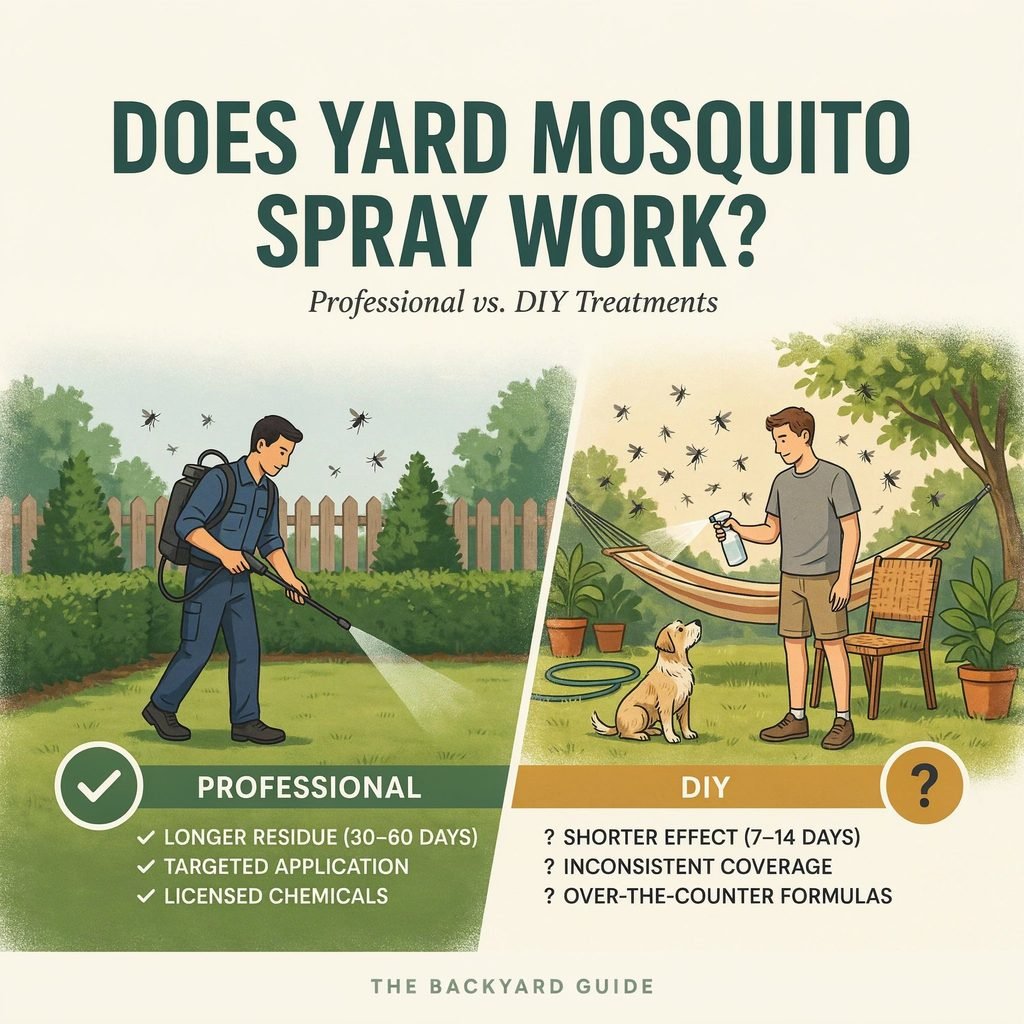
Most professional-grade barrier sprays last two to four weeks, depending on rainfall, UV exposure, and irrigation schedules. DIY concentrates may stretch to two weeks under ideal conditions, while fogging offers only a brief knockdown.
Understanding these distinctions is critical because many homeowners grab a fogger, see dead mosquitoes the next morning, and assume the problem is solved—only to be overwhelmed again by day three.
Do DIY Mosquito Sprays Actually Work?
Let’s be straightforward: DIY mosquito fogger effectiveness is real but limited. A canister fogger from Raid or a hose-end sprayer loaded with Ortho BugClear can knock down active mosquitoes in your yard for a day or two. If you’re hosting a Saturday barbecue and need quick relief, that’s genuinely useful.
However, DIY treatments hit several walls:
- Inconsistent coverage. Without calibrated equipment, it’s easy to miss the dense shrubs, under-deck areas, and fence perimeters where mosquitoes actually rest. You spray the visible grass and call it done while the real population hides ten feet away.
- Short residual life. Most consumer foggers and ready-to-use trigger sprays lose effectiveness within 24–72 hours. Even concentrates mixed in a backpack sprayer rarely maintain a strong residual past 10–14 days, especially after a summer thunderstorm or daily irrigation.
- No source reduction. Spraying adults does nothing about the eggs hatching in the clogged gutter, the saucer under your potted plant, or the low spot in the yard that holds water after rain.
- Dosage guesswork. Over-applying wastes product and raises safety concerns; under-applying barely dents the population.
Common DIY Options
- Ready-to-use sprays (Off!, Cutter, Repel backyard formulas): convenient, inexpensive ($12–$25), best for small patios.
- Concentrates + hose-end or backpack sprayers (Ortho, Bonide, Spectracide): better coverage for mid-size yards, roughly $25–$60 per bottle.
- Thermal foggers and ULV foggers: dramatic knockdown, fun to operate, but the effect evaporates fast.
- Natural/organic DIY blends: essential oil mixes (cedarwood, lemongrass, peppermint) and vinegar solutions. These can repel mildly but rarely kill or provide meaningful residual control.
When DIY Makes Sense
DIY mosquito yard spray is a reasonable choice if you have a small urban lot (under ¼ acre), need occasional relief for a weekend gathering, are working within a tight budget, or want to supplement source-reduction habits like dumping standing water weekly. For anything larger or more persistent, most homeowners hit diminishing returns fast.
Professional Mosquito Control: What You Get
Professional mosquito control operates on a different level of precision. Here’s what a typical residential mosquito treatment visit includes:
- Property inspection. A technician walks your yard identifying mosquito breeding sites in the yard—clogged gutters, low-lying puddles, dense ivy, woodpiles—and flags resting hotspots.
- Calibrated barrier application. Using commercial-grade sprayers, the tech applies a pyrethroid mosquito spray (or a natural alternative, if you request one) at label-rate concentrations to shrubs, fence lines, under decks, and shaded beds. Coverage is even and thorough.
- Targeted larvicide. If you have a pond, French drain, or recurring standing water, Bti dunks or granular larvicide go in.
- Follow-up schedule. Most companies offer seasonal packages—typically every 21 to 28 days from early spring through first frost. In the Southeast (think Georgia, Florida, the Carolinas), that can mean March through November. In the Midwest and Northeast, the season may run May through September.
Performance data from major providers (Mosquito Joe, Mosquito Squad, local independents) consistently shows a 70–90% reduction in adult mosquito activity within 24 hours of a barrier application, with suppression holding for two to three weeks under normal weather.
Plans can be customized: one-time event sprays for weddings or parties, full-season packages, or add-ons like tick and flea control for the yard perimeter. Many companies also include a between-treatment re-spray guarantee if mosquitoes rebound after heavy rain.
Cost Comparison: Professional vs. DIY
Here’s how the numbers stack up for a typical US suburban yard (roughly ½ acre):
| Factor | DIY Mosquito Spray | Professional Treatment |
|---|---|---|
| Upfront cost per application | $20–$60 (consumer products) | $90–$200 (one-time service) |
| Seasonal cost (approx.) | $150–$300+ (multiple purchases) | $400–$900 (seasonal plan, 6–8 visits) |
| Coverage quality | Variable, often incomplete | Calibrated, targeted, full-yard |
| Residual effect | 1–3 days (foggers); up to 2 weeks (concentrates) | 2–4 weeks per application |
| Time & effort | High (mixing, spraying, repeating) | Low (technician handles everything) |
| Safety & precision | Homeowner-applied; risk of over/under-use | Trained applicators, label-compliant |
The cost of professional mosquito spraying averages $60–$115 per visit when bundled into a seasonal plan. Factor in the time you save, the superior coverage, and the longer residual, and many homeowners find the mosquito barrier treatment cost comparable to—or only modestly higher than—repeated DIY purchases that underperform.
For mosquito control for large yards (one acre or more), professional pricing scales but often remains more efficient than buying enough DIY concentrate to cover the full property evenly.
Safety: Are Mosquito Sprays Safe for Kids, Pets, and Pollinators?
This is the question every parent and pet owner asks, and rightly so. Here’s the practical breakdown.
Re-entry times. Most professional barrier treatments require you to keep kids and pets off the yard for 30 minutes to 2 hours, or until the spray is fully dry. Once dry, the residue binds to foliage and poses minimal contact risk.
Pet-safe mosquito spray for yard concerns are valid. Keep pets indoors during application, remove water bowls and toys from the treatment zone, and cover fish ponds. Pyrethroids can be toxic to cats and aquatic life in concentrated form, which is why professional applicators follow strict label directions and avoid spraying near water features unless using a labeled aquatic-safe product.
Kids. The same re-entry window applies. Once foliage is dry, normal play is fine. Avoid letting toddlers chew on treated leaves (a good general rule regardless).
Pollinators. Responsible applicators avoid spraying flowering plants during bloom and target shaded, non-flowering resting areas instead. If you keep beehives or a pollinator garden, notify the company so they can buffer those zones.
DIY safety risks are higher simply because homeowners may over-apply, spray into the wind, or treat patio furniture, pet beds, and children’s play structures unintentionally.
Natural and organic options. If you prefer an organic mosquito control approach, many pros now offer essential-oil-based barrier sprays (cedarwood, rosemary, geraniol blends). They’re gentler on pollinators but typically need reapplication every 10–14 days rather than three to four weeks. Bti larvicides remain the gold standard for standing water mosquito prevention—highly targeted, safe for pets, wildlife, and humans.
How to Choose the Right Mosquito Control for Your Yard
Use this quick framework:
- Small urban lot (< ¼ acre), mild mosquito pressure: DIY concentrate sprays plus diligent standing-water elimination may be enough.
- Mid-size suburban yard (¼–½ acre), moderate pressure near woods or a creek: A seasonal professional plan gives consistent relief; supplement with DIY maintenance between visits.
- Large property (1+ acre), high pressure near wetlands (common in the Southeast and Gulf Coast): Professional treatment is almost essential for meaningful control. Look for companies experienced in mosquito control for large yards.
- Safety-first households (toddlers, multiple pets, pollinator gardens): Ask specifically about natural barrier options, Bti-based larvicide programs, and precise application methods.
Hybrid strategies often deliver the best value: hire a pro for monthly barrier sprays during peak season, and handle weekly source reduction yourself—dump saucers, clean gutters, trim dense shrubs, run oscillating fans on the patio.
Questions to ask a pro before signing:
- What active ingredient do you use, and is a natural option available?
- What is the re-entry time?
- Do you guarantee re-sprays after heavy rain?
- Can you work around my pollinator garden and fish pond?
Realistic Expectations & Maintenance Tips
No spray—professional or DIY—eliminates 100% of mosquitoes. Neighboring properties, wooded lots, and municipal storm drains constantly reseed your yard. Think of mosquito yard spray as a powerful reduction tool, not a force field.
To maximize results between treatments:
- Eliminate standing water weekly. Flip buckets, empty plant saucers, unclog gutters, and fill low spots where puddles linger. This is the single most effective form of standing water mosquito prevention.
- Mow and trim. Mosquitoes rest in tall grass and dense shrubs. Keep vegetation tidy, especially near seating areas.
- Use fans. Mosquitoes are weak fliers. A simple oscillating fan on the patio disrupts their flight and makes outdoor dinners far more pleasant.
- Mind your landscaping. Avoid thick groundcover right next to patios and play areas; opt for open, airy plantings in high-use zones.
- Coordinate with neighbors. If three houses on the block treat but one doesn’t, mosquitoes will drift in. A friendly chat (or split cost) can help.
Combining chemical or natural treatments with habitat management is how you get the best mosquito yard spray results and actually enjoy your summer evenings.
FAQ
How long does yard mosquito spray last?
Professional barrier treatments typically last two to four weeks. DIY concentrates may hold for one to two weeks, while foggers fade within one to three days. Rain, heavy irrigation, and intense UV shorten residual life.
How often should I spray my yard for mosquitoes?
For DIY products, every 7–14 days during peak season. Professional plans usually schedule mosquito spraying frequency at every 21–28 days from spring through early fall.
Is professional mosquito control worth the cost?
For most mid-size to large US yards with moderate-to-high mosquito pressure, yes. You get stronger residual, even coverage, and expert source-reduction advice—often for less than you’d spend on repeated DIY products that underperform.
What is the best time of day to spray for mosquitoes?
Early morning or late evening, when mosquitoes are most active and winds are calm. Avoid midday heat, which causes rapid evaporation and drift.
Are natural mosquito sprays as effective as chemical ones?
Natural essential-oil sprays reduce mosquito activity but typically last 10–14 days versus three to four weeks for pyrethroid-based products. They’re a solid choice for eco-conscious households but require more frequent reapplication.
Can I spray my yard if I have a dog or kids?
Yes, with precautions. Keep pets and children indoors during application and until the spray is fully dry (usually 30 minutes to 2 hours). Remove water bowls and toys first. Always follow label directions.
Will mosquito spray hurt bees or butterflies?
Pyrethroids can harm pollinators if applied directly to blooming flowers. Reputable technicians avoid flowering plants and spray during low-pollinator-activity hours. Natural and Bti-based options carry minimal pollinator risk.
Do mosquito misting systems work better than sprays?
Mosquito misting systems vs. spray is a common question. Automatic misting systems release timed bursts of insecticide and can provide convenient daily knockdown, but they offer less targeted coverage than a professional barrier spray and require maintenance and refill costs. For most homeowners, periodic barrier treatments deliver better residual control per dollar.
Conclusion
So, does yard mosquito spray work? Absolutely—but the degree of relief depends on the product, the application method, and the consistency of your overall strategy. DIY foggers and sprays can buy you a weekend of comfort. Professional barrier treatments deliver weeks of measurable reduction, applied safely and thoroughly by trained technicians.
For most US homeowners juggling work, kids, pets, and a yard that deserves to be enjoyed, the winning formula is straightforward: pair a seasonal professional mosquito treatment plan with weekly DIY source reduction—dump the standing water, trim the shrubs, run a fan on the patio.
If you’re tired of swatting mosquitoes every single evening, start this week by walking your property and eliminating every puddle, saucer, and clogged gutter you can find. Then get quotes from two local mosquito control companies, compare their products, re-entry policies, and seasonal pricing, and book your first treatment before the next warm evening arrives. Your backyard—and your sanity—will thank you.