Every summer, homeowners across the United States spot a striped insect buzzing near the patio, the garbage cans, or the eaves of the house—and immediately wonder, “Is that a wasp, a hornet, or a yellow jacket?” The confusion is understandable. All three belong to the same broad insect family, share similar body shapes, and can deliver a painful sting. But the difference between wasps, hornets, and yellow jackets matters more than most people realize.
Here is the key point: “wasp” is a broad category. Hornets and yellow jackets are actually types of social wasps. Paper wasps, bald-faced hornets, and yellow jackets all fall under the umbrella of stinging insects that build colonies, defend nests, and interact with humans around homes and yards.
Correct identification matters because nesting behavior, aggression levels, and treatment approaches differ significantly among these insects. A small open comb nest under a porch ceiling calls for a very different response than a large enclosed gray nest in a tree or a yellow jacket nest in the ground beside a sidewalk. This guide will help you identify what you are dealing with, understand the risks, explore safe treatment options, and know when to call in professional pest control for wasps and other stinging insects.
Important Disclaimer: If you or anyone in your household has a known wasp sting allergy, if a nest is located inside a wall, attic, or other structure, if the colony is large or difficult to access, or if you are uncertain about the species, please contact a licensed pest-control professional before attempting any treatment. Do not attempt DIY removal in these situations.
Quick Comparison: Wasps vs. Hornets vs. Yellow Jackets
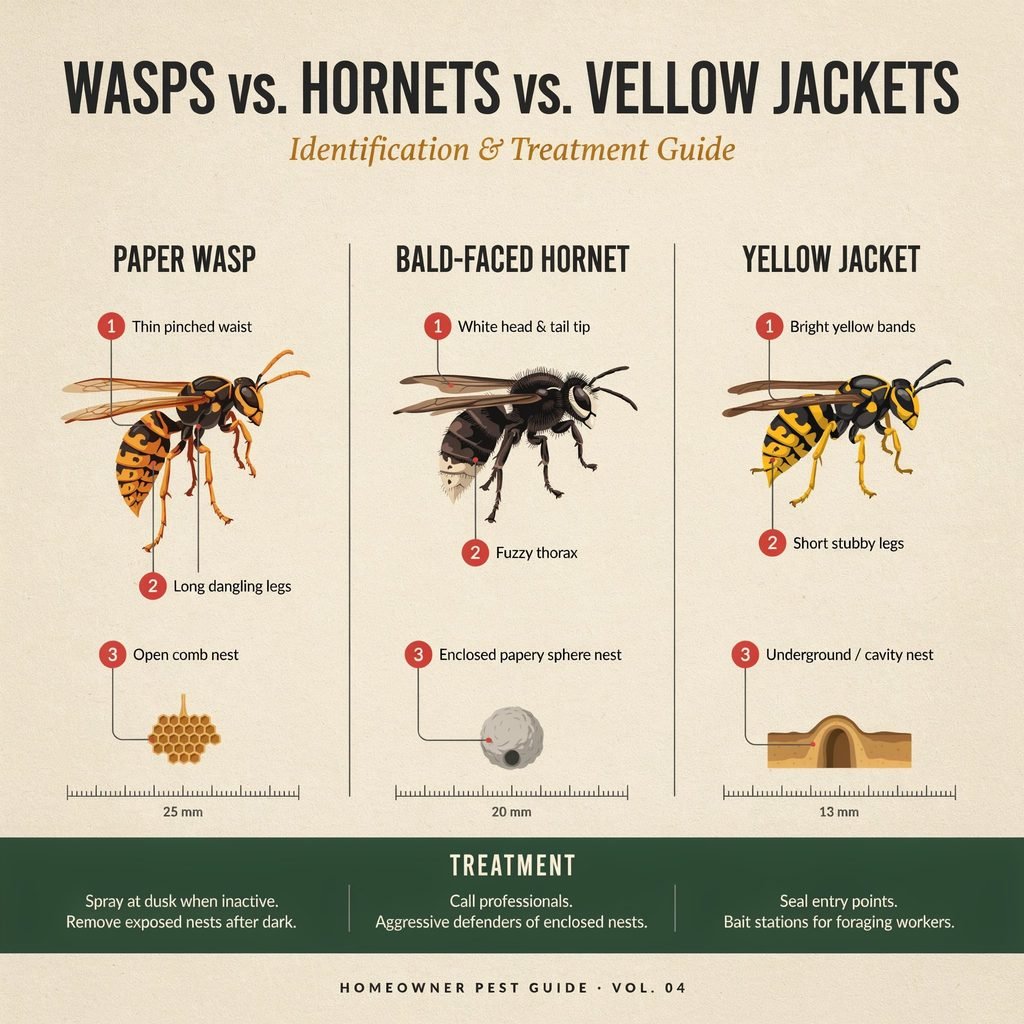
The table below summarizes the difference between wasps, hornets, and yellow jackets so you can quickly narrow down what you are seeing around your property.
| Feature | Paper Wasps | Bald-Faced Hornets | Yellow Jackets |
|---|---|---|---|
| Appearance | Slender, smooth body, long legs, narrow waist | Larger, robust, black with white/ivory face markings | Compact, smooth, bright black-and-yellow markings |
| Typical Size | ⅝ to ¾ inch | ¾ to 1 inch (queens slightly larger) | ⅜ to ⅝ inch |
| Color & Markings | Reddish-brown, black-and-yellow, or dark with orange tips | Black body with white or ivory facial and body markings | Bold black-and-yellow stripes; no fuzz |
| Nest Location & Type | Open comb nest (umbrella-shaped) under eaves, porches, shutters | Enclosed gray nest, football-shaped, in trees, shrubs, rooflines | Underground nest, wall void, or enclosed paper-like nest in cavities |
| Usual Behavior | Moderate; forage for caterpillars and nectar | Defensive near nest; forage for insects and sap | Scavenge for protein-based foods, sugary drinks, and garbage |
| Aggression When Disturbed | Moderate; sting if nest is threatened | High; can swarm if nest is disturbed | High; especially defensive in late summer and early fall |
| Common Places Around Homes | Porch ceilings, deck railings, fences, sheds, shutters | Trees near rooflines, sheds, attics, soffits | Ground-level holes, crawl spaces, attics, near garbage cans, picnic areas |
| Best Response | Monitor small nests; treat or call a pro for accessible nests | Call a licensed exterminator; do not approach | Call a professional, especially for underground or hidden nests |
These three represent the most common social wasps homeowners encounter in the United States. Knowing how to identify wasps, hornets, and yellow jackets is the first step toward safe, effective stinging insect control.
How to Identify Wasps
When most people say “wasp,” they are usually thinking of paper wasps. These insects have slender, smooth bodies with a distinctly narrow waist connecting the thorax to the abdomen. Their legs hang down visibly during flight, and their coloring ranges from reddish-brown to black-and-yellow, depending on the species.
Wasp nest identification for paper wasps is straightforward. They build open comb nests—flat, umbrella-shaped structures with visible hexagonal cells and no outer envelope. The material looks papery because the wasps chew wood fibers and mix them with saliva. You will typically find a nest under eaves, on porch ceilings, beneath shutters, along fences, on decks, or inside open sheds and outbuildings.
Paper wasps are generally less aggressive than yellow jackets or hornets, but they will sting if they feel their nest is threatened. A single paper wasp foraging on a flower is usually not a concern. A cluster of workers around a nest directly above your front door is a different story.
How to Identify Hornets
Hornets are the largest members of the social wasp family. In the United States, the most commonly encountered species is the bald-faced hornet, which despite its name is technically a type of yellow jacket in the genus Dolichovespula. True European hornets are present in some eastern states but are less common.
Hornet vs. wasp identification comes down to size and nest style. Bald-faced hornets are stockier than paper wasps, with a black body marked by white or ivory patterns on the face and abdomen. They build large, enclosed gray nests that resemble an upside-down teardrop or football. The outer shell is made of layered paper-like material with a single entrance hole near the bottom.
Hornet nest identification tip: look for these enclosed gray nests in trees, tall shrubs, along rooflines, under soffits, inside sheds, or occasionally in attics and wall voids. A mature colony can contain several hundred worker insects and a single queen.
Hornets can be highly defensive around an active nest. Vibrations from mowing, trimming, or even loud activity nearby can trigger a swarm response. For this reason, hornet removal is best left to a licensed exterminator who has the protective equipment and EPA-registered products to handle the job safely.
How to Identify Yellow Jackets
Yellow jackets are the stinging insects most homeowners run into at barbecues, around garbage cans, and near outdoor dining areas. They have compact, smooth bodies with bold black-and-yellow markings. Unlike hairy bees, yellow jackets lack any fuzz, which gives them a sleek, almost shiny look.
A common yellow jacket vs. wasp question is whether they are different insects. Yellow jackets are a type of wasp, but their behavior sets them apart. They are scavengers, drawn to protein-based foods, sugary drinks, fallen fruit, and open trash. This is why they dominate picnic tables in late summer and early fall, when colony populations peak and natural food sources dwindle.
Yellow jacket nest identification can be tricky because many colonies are hidden. A yellow jacket nest in the ground often uses an abandoned rodent burrow or a gap in landscaping. They also nest in wall voids, crawl spaces, attics, behind siding, and under decks. Above-ground aerial nests are possible but less common than concealed locations.
Late summer activity is a hallmark of yellow jackets. As the colony grows and the queen stops producing workers, foragers become more aggressive and more likely to investigate human food sources.
Wasp vs. Hornet vs. Yellow Jacket: Key Differences That Matter
Understanding the difference between wasps, hornets, and yellow jackets helps you gauge risk and choose the right response.
- Nest style: Paper wasps build open comb nests. Bald-faced hornets build enclosed gray nests. Yellow jackets favor hidden, enclosed locations, including underground nests.
- Nest location: Paper wasp nests are usually visible. Hornet nests hang in trees or on structures. Yellow jacket nests are often concealed in the ground or inside walls.
- Size: Hornets are the largest. Paper wasps are medium. Yellow jackets are the smallest of the three.
- Food behavior: Paper wasps and hornets primarily hunt other insects. Yellow jackets scavenge human food, garbage, and sugary liquids.
- Encounter likelihood at meals: Yellow jackets are by far the most likely to crash your outdoor dining experience.
Underground or hidden yellow jacket nests are particularly hazardous because a homeowner may not know they are there until a lawn mower, a footstep, or a pet disturbs the entrance. The result can be a sudden, painful swarm.
Do Not Confuse Them With Bees
Honey bees and bumble bees are hairy, rounder, and generally fuzzier than any wasp. Bees are critical pollinators, and honey bees in particular should be relocated by a beekeeper whenever possible rather than exterminated. If you see a round, fuzzy insect entering a hole in the ground or a wall, pause and look closely before assuming it is a yellow jacket. When in doubt, contact a local extension office or pest-control professional for identification.
Are Wasps, Hornets, and Yellow Jackets Dangerous?
All three can sting more than once. Unlike honey bees, which leave their stinger behind, wasps, hornets, and yellow jackets have smooth stingers that allow repeated stings.
Situations that raise risk include:
- Disturbing or poking a nest
- Mowing over a ground nest
- Blocking an active entry hole, which traps insects and may drive them indoors
- Swatting at foraging insects
- Creating strong vibrations near a colony (trimming, hammering, pressure washing)
For most healthy adults, a sting causes localized pain, swelling, and redness. However, a wasp sting allergy can turn a single sting into a medical emergency. Call 911 or seek emergency medical care immediately if anyone experiences:
- Trouble breathing or wheezing
- Swelling of the face, lips, tongue, or throat
- Dizziness, fainting, or a rapid drop in blood pressure
- Widespread hives beyond the sting site
- Nausea or vomiting accompanying any of the above symptoms
These are signs of anaphylaxis. Do not wait to see if symptoms improve.
Safe Treatment Options for Homeowners
Safety first. Do not attempt DIY wasp nest treatment if:
- The nest is large (larger than a tennis ball) or highly active
- It is located inside a wall, attic, soffit, or crawl space
- It is high up or difficult to reach safely
- It is near a doorway, play area, pool, or frequently used space
- Anyone in the household has a known sting allergy
If you are dealing with a small, accessible aerial nest—such as a young paper wasp comb under a porch ceiling—and no allergy risk exists, an EPA-registered aerosol product labeled for wasps may be appropriate. Always read and follow the insecticide label exactly. Treatment is generally performed at dusk or early morning when insects are less active and most workers are inside the nest. Wear long sleeves, pants, closed-toe shoes, and avoid standing directly beneath the nest.
Important cautions:
- Never seal an active entry point. Trapping insects inside a wall void can push them indoors through cracks, outlets, or gaps in siding.
- Never use fire, gasoline, boiling water, or unverified home remedies. These methods are dangerous, often ineffective, and can cause property damage or serious injury.
- Traps can help reduce foraging yellow jackets near a patio or deck, but they will not eliminate an active colony. Treat traps as a supplemental tool, not a complete yellow jacket nest treatment.
- For underground nests, wall voids, and large hornet colonies, professional dust or targeted treatment applied by a technician is the responsible choice.
Pest control safety means matching the method to the situation. Integrated pest management principles encourage the least risky effective approach, and often that approach is calling a professional.
When to Call a Professional Exterminator
Some situations are simply not safe or practical for DIY wasp removal, yellow jacket removal, or hornet removal. Call a licensed pest-control professional if:
- The nest is inside a wall, attic, crawl space, or roof void
- You see yellow jacket activity around a ground-level hole
- The nest is large, highly active, or in a hard-to-reach location
- It is near a doorway, playground, patio, pool, or other high-traffic area
- You have found multiple nests on the property
- Anyone in the household has a wasp sting allergy
- You are unsure of the species
- A previous DIY treatment did not resolve the problem
A trained technician can correctly identify the insect, locate hidden nest entrances, apply appropriate registered products, and offer guidance to reduce the chance of repeat nesting. Professional pest control for wasps is an investment in safety, especially for families with children, pets, or allergy concerns.
Prevention Tips: Keep Wasps, Hornets, and Yellow Jackets Away
The best approach to stinging insect control is stopping a colony before it grows. These steps will help you prevent wasps around your house and reduce attractants:
- Secure trash. Keep garbage can lids tightly closed and rinse recyclables before tossing them.
- Manage food outdoors. Cover food and sugary drinks during barbecues and outdoor dining. Clean up spills promptly.
- Remove fallen fruit. Rotting fruit on the ground attracts yellow jackets and other scavengers.
- Inspect in spring. Check eaves, soffits, decks, sheds, and outdoor structures for early nest building. Catching a small paper wasp comb in April is far easier than dealing with a mature colony in August.
- Seal entry points. After confirming no active insects remain, caulk cracks, gaps around siding, and openings near the soffit, attic vents, and foundation.
- Repair screens and siding. Torn window screens and loose siding panels invite nesting.
- Reduce nesting sites. Clear clutter from under decks, inside storage sheds, and around play equipment.
- Maintain landscaping. Monitor shrubs, ground cover, and old rodent burrows for signs of yellow jacket activity. Keep grass and vegetation trimmed near the house.
Early-season detection is your greatest advantage. A queen starting a colony in spring has only a handful of worker insects. By late summer, that same colony may contain hundreds.
Frequently Asked Questions
Which is more aggressive: wasps, hornets, or yellow jackets?
Yellow jackets and bald-faced hornets tend to be more defensive than paper wasps, especially near their nests. Yellow jackets are also more likely to approach humans because they scavenge food. All three will sting if provoked.
How can I tell if a nest is active?
Watch for steady insect traffic entering and exiting the nest during daylight hours. An active nest will show visible movement. If no insects appear over several warm days, the colony may be abandoned, but exercise caution before touching any structure.
Do yellow jackets nest in the ground?
Yes. A yellow jacket nest in the ground is one of the most common scenarios in the US. They often use abandoned rodent burrows or gaps in landscaping. They also nest in wall voids, attics, and crawl spaces.
Can wasps, hornets, and yellow jackets sting more than once?
Yes. All three have smooth stingers and can sting repeatedly, unlike honey bees. This is one reason disturbing a colony is so risky.
Should I remove an old wasp nest?
An old, abandoned nest from a previous season is generally harmless and can be knocked down with a long pole once you are certain no insects remain. Wasp colonies do not reuse old nests, but a nearby queen may build a new one the following spring.
What attracts yellow jackets to my yard?
Open garbage cans, uncovered food, sugary drinks, fallen fruit, and protein-based foods are major draws. Yellow jackets are especially persistent around outdoor dining areas in late summer and early fall.
Can I seal a hole where yellow jackets are entering my house?
Not while the colony is active. Sealing the entrance traps insects inside the wall and may push them indoors through other gaps. Have the colony treated by a professional first, then seal the entry point.
When is the safest time to remove a nest?
For small, accessible nests, dusk or early morning is best because insects are less active and most workers are inside. However, timing alone does not make a risky nest safe. When in doubt, call a professional.
Are hornets and yellow jackets the same thing?
Not exactly. Both are social wasps, but they differ in size, appearance, and nesting habits. Bald-faced hornets are technically a type of yellow jacket in the genus Dolichovespula, while true hornets belong to the genus Vespa. For homeowners, the practical difference is nest size, location, and defensiveness.
Conclusion
The question of wasps vs. hornets vs. yellow jackets comes down to one thing: knowing what you are looking at so you can respond safely and effectively. Paper wasps, bald-faced hornets, and yellow jackets each present different nesting challenges, different aggression levels, and different treatment considerations. Accurate identification is the foundation of responsible stinging insect control.
Focus on prevention—secure your trash, inspect your eaves and soffits each spring, and reduce food attractants around your patio and deck. For small, visible, low-risk nests, a carefully applied, label-directed treatment may be appropriate. For anything hidden, large, high up, or near your family’s daily activity, professional help is the smart and safe choice.
If you are unsure what is nesting around your home, contact a local licensed pest-control professional for an inspection. A quick identification call today can prevent a painful, dangerous surprise tomorrow.