Safety Disclaimer: This article provides general homeowner information only. It does not replace advice from a licensed pest-control professional or emergency medical provider. If you or a family member experiences multiple stings, difficulty breathing, swelling of the face or throat, or signs of anaphylaxis, call 911 immediately.
Discovering a wasp nest in your attic or wall cavity is unsettling—and for good reason. Unlike a paper wasp nest hanging openly under an eave where you can see it, avoid it, and treat it from a safe distance, a hidden wasp nest tucked behind drywall, buried in attic insulation, or wedged inside a soffit is something you cannot simply walk away from. The wasps are still there, still building, and still defending their colony. They just happen to be doing it out of sight.
The risks are real. A concealed nest means stinging insects are operating inches from your living space. Wasps can slip through gaps around electrical outlets, ceiling fixtures, and vent covers, turning a wall-void problem into wasps coming into house territory within days. For anyone with an insect sting allergy, even a single encounter can become a wasp sting emergency. Children, pets, and older adults face elevated risk simply because they may not recognize the danger or react quickly enough to move away.
The good news? A wasp infestation in house structures is solvable. Prompt, cautious action—combined with the right professional help when needed—can eliminate the colony, protect your family, and restore peace of mind. This guide walks you through every step, from confirming the problem to preventing a repeat visit next season.
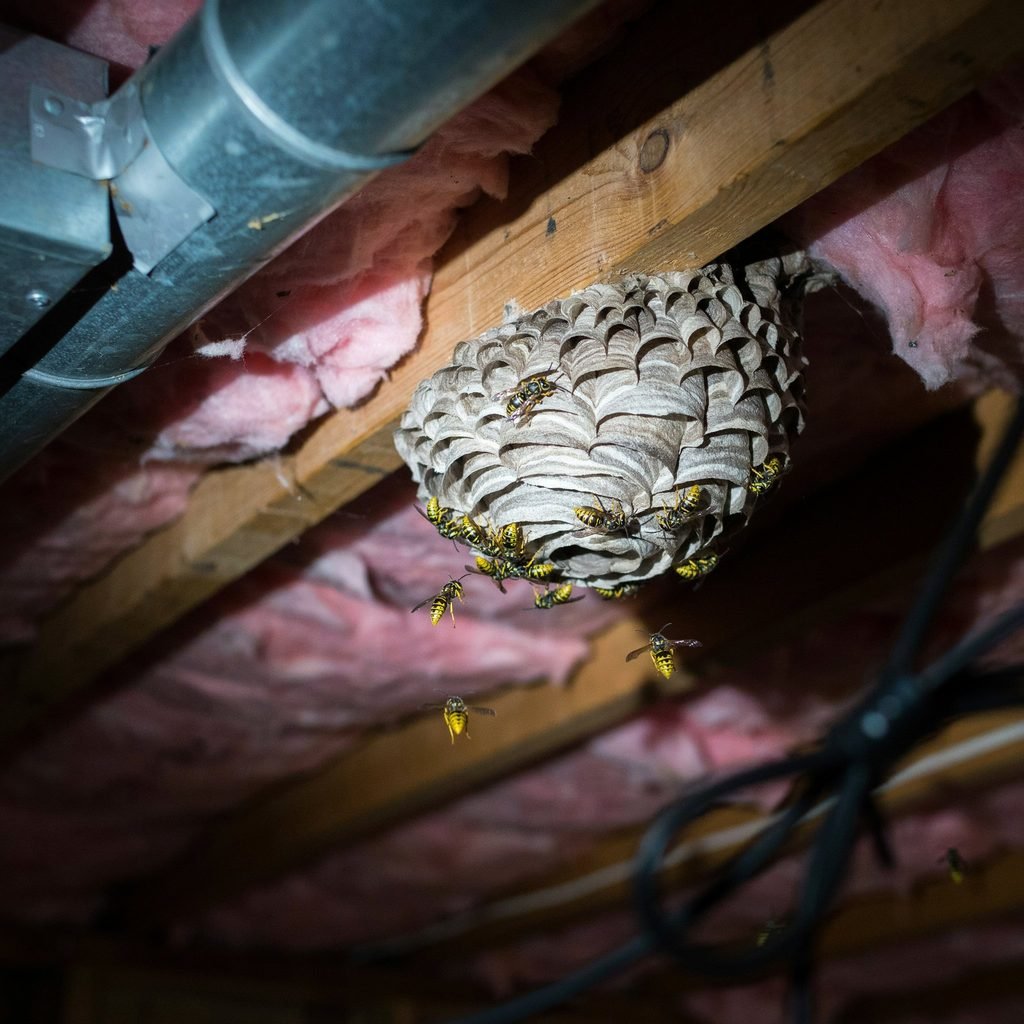
Quick Answer: If you find or suspect a wasp nest in your attic or wall cavity, do not disturb it, block the entrance, or spray randomly. Keep people and pets away, close interior doors if wasps are entering living spaces, and contact a licensed pest-control professional for safe inspection and treatment.
How to Tell If You Have a Wasp Nest in an Attic or Wall
Recognizing the signs of a wasp nest early gives you more options and reduces the chance of an unpleasant surprise. Here is what to watch for:
Visual Clues Outside the Home
- Repeated wasp traffic near soffits, fascia boards, attic vents, rooflines, or chimneys
- Wasps disappearing into a siding gap, crack around a window frame, or hole where a utility line enters the wall
- A steady stream of yellowjackets or hornets entering and exiting a single wasp entry point on the exterior
- Small piles of chewed wood fibers or papery debris beneath an eave or vent opening
Auditory and Indoor Clues
- A faint buzzing in walls, ceiling, or attic, especially on warm afternoons when colony activity peaks
- Light scratching or rustling sounds behind drywall or above a ceiling
- One or two wasps appearing indoors near a light fixture, outlet, or window with no obvious outdoor entry
- Seeing wasps in the attic when you open the hatch to check storage or wiring
Know Your Stinging Insect
Not every buzzing insect is the same threat. Understanding the differences helps you communicate accurately with a pest-control professional:
- Paper wasps build open, umbrella-shaped nests, often under eaves. They are generally less aggressive but will sting if provoked.
- Yellowjackets favor enclosed spaces—wall voids, attics, ground burrows. A yellowjacket nest in wall cavities can grow to thousands of workers by late summer.
- Bald-faced hornets construct large, enclosed aerial nests, sometimes in attics or near rooflines. They defend aggressively.
- Honeybees may cluster in wall voids but are beneficial pollinators and often require relocation rather than extermination.
- Mud daubers build small, tubular mud nests and rarely sting. They are more nuisance than danger.
If you are unsure which species you are dealing with, do not get close enough to find out. Note the color, size, and behavior from a distance and share that information with your exterminator for wasps.
Why You Should Not Disturb a Hidden Wasp Nest
It is tempting to grab a can of spray, knock on the wall to “see what happens,” or seal the hole with caulk. Resist that urge. A hidden wasp nest is volatile, and disturbing it without proper training and protective equipment can trigger a coordinated defensive response.
- Vibration and noise from drilling, hammering, or even loud music near the nest can agitate the colony.
- Knocking on drywall or ceiling panels may cause wasps to swarm the interior side of the wall.
- Sealing an active entrance traps workers inside, forcing them to chew or push through interior gaps into your living space.
- Random spraying into a hole rarely reaches the core of the nest and can scatter agitated wasps throughout the wall void.
- Removing drywall or insulation without treatment exposes you directly to thousands of defensive insects.
The consequences are most severe for households that include young children, curious pets, older adults with limited mobility, or anyone carrying an EpiPen for a known insect sting allergy. Yellowjackets and hornets, in particular, can sting repeatedly and will pursue a perceived threat several feet from the nest.
What to Do Immediately
Once you confirm or strongly suspect a wasp nest in your attic or wall cavity, follow these steps:
- Keep people and pets away. Close the door to the affected room. Keep children and animals out of the attic or the area below the wall void.
- Do not block the entrance. Wasps need their current flight path. Sealing it while the colony is active redirects them indoors.
- Close interior doors and windows near the affected area to limit wasp movement into living spaces.
- Identify the outdoor entry and exit points from a safe distance—ideally 15 to 20 feet away. Note the time of day when traffic is heaviest.
- Take photos or short video from afar if you can do so safely. This helps a pest-control professional assess species, nest size, and access requirements before arriving.
- Avoid using the attic, running loud appliances near the wall, or turning on recessed ceiling lights that generate heat near the nest.
When to Call 911
If anyone in the household sustains multiple stings, shows signs of anaphylaxis (hives, throat swelling, difficulty breathing, dizziness, rapid pulse), or loses consciousness, call 911 or your local emergency number immediately. A wasp sting emergency can escalate within minutes.
Should You Remove a Wasp Nest Yourself?
This is the question most homeowners ask first, and the honest answer is: it depends on several factors.
DIY removal may be reasonable only when all of the following are true:
- The nest is small (fewer than a dozen wasps visible).
- It is fully visible and accessible without a ladder or confined-space entry.
- It is located well away from doors, windows, play areas, and high-traffic paths.
- No household member has a sting allergy.
- You can follow the insecticide label directions exactly, including applying treatment at dusk or dawn when wasps are less active.
In every other scenario—especially a wasp nest in wall cavities, attics, ceiling voids, roof spaces, or anywhere you must use a ladder, remove building materials, or work near electrical wiring—call a licensed pest-control professional. The risk-to-reward ratio simply does not favor DIY.
Methods to Avoid Entirely
Never attempt to remove wasp nest structures using:
- Gasoline, kerosene, or any accelerant
- Open flame, smoke bombs, or fireworks
- Bleach, ammonia, or unapproved household chemicals
- Expanding foam injected into an active entrance
- Shop-vacuums without proper containment
These approaches are dangerous, often illegal under local fire codes, ineffective at eliminating the colony, and can provoke a massive defensive swarm.
When to Call a Professional Exterminator
If any item on the following checklist applies to your situation, contact residential pest control services rather than attempting self-treatment:
- The nest is inside a wall cavity, attic, ceiling void, or roof space.
- The colony is large, growing, or you see dozens of wasps daily.
- The species is yellowjackets, bald-faced hornets, or another aggressive type.
- Wasps are entering the interior of your home.
- You cannot locate the nest despite visible wasp traffic.
- A household member has a documented insect sting allergy.
- Access requires a ladder above six feet, crawling through insulation, or working near electrical wiring.
- The wasp nest is near the roof peak, chimney flashing, or another structurally complex area.
What a Professional Will Do
A licensed technician providing attic pest control or wall void pest control will typically:
- Perform a thorough inspection to identify the species, locate the nest, and map entry points.
- Recommend a targeted treatment plan—often a dust or aerosol insecticide applied directly into the void.
- Return for follow-up visits if needed to confirm the colony is eliminated.
- Advise on safe removal of nest material when appropriate.
- Provide exclusion recommendations to seal wasp entry holes and prevent re-infestation.
Professional wasp removal typically takes one to three visits depending on colony size, species, and accessibility.
What Happens If You Seal a Wasp Nest Inside a Wall?
This is one of the most common mistakes homeowners make. You see wasps entering a gap in the siding, so you grab caulk or expanding foam and close it up. Problem solved, right? Unfortunately, no.
Sealing an active entrance traps hundreds or thousands of agitated workers inside the void. With their primary exit blocked, they will search for alternative routes—often pushing through:
- Gaps around electrical outlets and switch plates
- Cracks near ceiling light fixtures
- Spaces around HVAC vents and plumbing penetrations
- Joints where drywall meets trim or window frames
The result is wasps coming into house living areas in greater numbers than before, often in locations you never expected. The correct sequence is always: treat the colony first, confirm activity has stopped, then seal exterior entry points as a prevention measure. Sealing gaps is never the first response to an active hidden wasp nest.
After the Nest Is Treated or Removed
Once your pest-control professional confirms the colony is inactive:
- Wait the recommended period (usually 24 to 72 hours, or longer for large colonies) before repairing entry points. Follow your technician’s specific guidance.
- Clean up dead insects around the treatment area using a vacuum with a disposable bag. Wear gloves and long sleeves.
- Repair torn window screens, damaged vent covers, and cracked soffit panels.
- Seal cracks around soffits, fascia boards, and utility penetrations with exterior-grade caulk or hardware cloth.
- Check attic insulation for moisture damage or compression caused by the nest and repair or replace as needed.
- Monitor the area for several days to two weeks. A few stragglers are normal; sustained activity is not.
Abandoned paper nests do not cause long-term structural damage, but the entry holes the wasps exploited should still be repaired to keep out future colonies, rodents, and moisture.
How to Prevent Wasps From Nesting in Your Attic or Walls
Prevention is far easier—and cheaper—than removal. Incorporate these wasp prevention tips into your seasonal home maintenance:
- Seal gaps around siding, soffits, fascia boards, utility lines, and roof penetrations each spring before queens begin scouting for nest sites.
- Repair attic vents and install fine-mesh hardware cloth over soffit and gable vents to block entry while maintaining airflow.
- Fix torn window and door screens promptly.
- Keep outdoor trash cans tightly lidded and rinse recyclables before binning them.
- Clean up fallen fruit, sugary spills, and uneaten pet food from patios and decks.
- Inspect eaves, sheds, deck railings, and exterior walls monthly during spring and early summer, when founding queens are most active.
- Address moisture damage, rotted wood, and loose trim that create attractive nesting cavities.
- Schedule seasonal pest inspections if your property has experienced recurring wasp problems or is surrounded by wooded or agricultural land.
Taking these steps to prevent wasps from nesting dramatically reduces the odds of discovering a hornet nest in attic spaces or a yellowjacket colony behind your siding next summer.
FAQ: Wasp Nests in Attics and Walls
Can wasps chew through drywall?
Wasps do not chew through intact drywall the way rodents do. However, they can exploit existing cracks, gaps around wiring, and unfinished joints to move from a wall void into a room. In rare cases, a very large, long-established colony may weaken thin ceiling panels.
Will wasps leave a wall cavity on their own?
In most of the United States, a colony will die off after the first hard frost in late autumn. The queen does not reuse the nest the following year. However, leaving an untreated nest in place through summer means months of active stinging insects near your living space and a growing risk of indoor intrusion.
How long can a wasp nest survive in an attic?
A colony typically lasts one season—spring through late fall. In warm climates or heated attic spaces, activity may extend into early winter. The physical nest structure can persist for years but is not reused.
Can I seal a hole where wasps are entering?
Not while the colony is active. Treat the nest first, confirm zero wasp traffic for at least 48 hours, and then seal wasp entry holes with caulk, foam, or mesh.
Are wasps in the attic dangerous?
They can be, especially if the attic is accessed frequently, if the colony is large, or if a household member has a sting allergy. Even without direct contact, wasps may find routes into living spaces.
Do wasps return to an old nest?
Most species do not reuse an old nest. However, a queen may select the same sheltered void if entry points remain open. Removing or treating old nests and sealing gaps eliminates that attraction.
How much does professional wasp nest removal cost in the US?
Pricing varies widely by location, nest accessibility, species, urgency, and structural complexity. A straightforward exterior treatment may start around $100 to $250, while a large yellowjacket colony deep in a wall void or a hornet nest in an attic requiring specialized access can range from $300 to $600 or more. Always request a written estimate before work begins.
Final Thoughts
Finding a wasp nest in your attic or wall cavity is stressful, but it is a problem with a clear, proven solution. The key is to act calmly, avoid disturbing the colony, and bring in the right expertise before the situation escalates. Whether you are dealing with wasps in walls, a buzzing sound above your bedroom ceiling, or a stream of yellowjackets vanishing under your soffit, the safest path forward is the same: assess from a distance, protect your household, and let a trained professional handle the treatment.
If you have an active wasp nest in a concealed, difficult-to-reach, or high-risk location—inside a wall, up in the attic, near the roofline, or anywhere your family spends time—contact a licensed local pest-control company today. Most offer same-day or next-day inspections during peak wasp season (late spring through early fall), and a quick phone call can put you on the schedule before the colony grows any larger.
Your home should be your safe space. Don’t let a hidden wasp colony change that.
This article is for informational purposes only and does not constitute professional pest-control or medical advice. Always follow product labels, local regulations, and the guidance of licensed professionals.